Flooring Types Explained: How to Choose the Right One
Almost every flooring mistake comes from choosing in the wrong order. People pick a look first, then discover the room will not take it. Here is the order that works, and what the main flooring types are actually made of.
Why the order you choose in matters more than the material
A floor is not chosen well or badly in isolation. It is chosen well or badly for a specific room. Solid hardwood is a superb floor and a poor decision in a basement. Carpet is comfortable and the wrong answer beside a back door. The material is rarely the problem, and the mismatch almost always is.
That is why this guide sorts the flooring types by construction rather than appearance. Once you know what a floor is made of, where it belongs becomes obvious, and the shortlist narrows itself before you ever look at a colour.
Work through four questions in this order.
- Moisture. Is the room below grade, over a concrete slab, or routinely wet? This one question eliminates more options than any other.
- Traffic. Entryways, kitchens, hallways, pets and children all push you toward a harder wear surface.
- Subfloor and height. What is underneath, is it flat, and how much height do you have at doorways?
- Renewability. Do you want to refinish this floor in fifteen years, or replace it?
Colour, plank width and finish come after those four. Reversing the order is the single most common way a flooring project goes wrong.
The six flooring types at a glance
Six flooring types cover almost every home. Cork, bamboo, natural stone and polished concrete fill specialist roles beyond them.
| Type | What it is | Handles moisture | Surface can be renewed |
|---|---|---|---|
| Solid hardwood | One solid piece of wood, usually 3/4 inch thick | Poorly | Yes, several times |
| Engineered hardwood | Real wood veneer over a plywood or composite core | Moderately | Sometimes, depends on veneer thickness |
| Laminate | Printed layer over a fibreboard core, sealed with melamine | Varies by product | No |
| Luxury vinyl | Printed vinyl layers over a rigid or flexible core | Well, many are waterproof | No |
| Tile | Fired clay, set in mortar with grout joints | Very well | No, but very long lived |
| Carpet | Fibre pile on a backing, laid over cushion | Poorly | No |
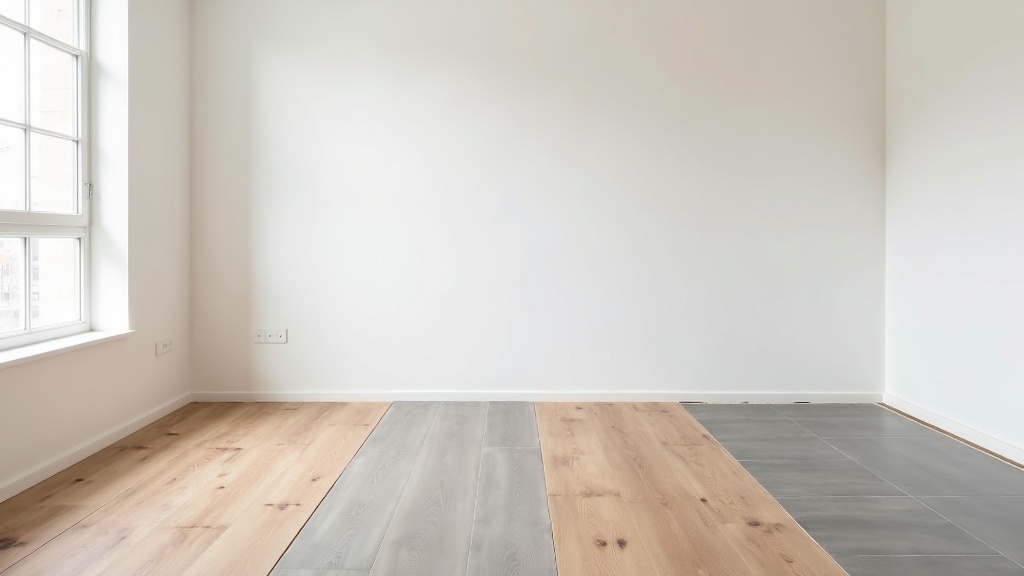
Solid hardwood: the only floor you can keep renewing
Solid hardwood is a plank milled from one piece of wood, traditionally 3/4 inch thick. Because it is solid throughout, it can be sanded and refinished several times, typically four to six over many decades, which is why original hardwood in century-old homes can still be brought back.
Its weakness is water. Wood moves with the moisture in the air, so solid planks belong above grade, over a wood subfloor, in rooms with reasonably stable humidity. Species matters too, and hardness is measured on the Janka scale, which presses a steel ball into the wood and reports the force required. Red oak sits at about 1,290 lbf and is the reference most species are judged against, white oak at roughly 1,360, hard maple around 1,450, and hickory near 1,820.
Choose it when you want a floor your grandchildren could refinish, and the room is dry and above grade.
Engineered hardwood: real wood that tolerates a slab
Engineered hardwood is a genuine hardwood veneer bonded to a plywood or composite core. The surface is real wood, so it is indistinguishable from solid once installed. The difference is underneath, where cross-layered construction resists the seasonal movement that makes solid planks cup or gap.
That stability is why it dominates in condos, over concrete, over radiant heat, and in basements. The number that matters is the wear veneer on top, commonly 0.6 mm to 6 mm. As a working rule, about 2 mm or more can take one careful sanding, 3 mm and up allows more than one, and under roughly 1 mm is a surface you live with as it is. Composite cores are regulated for formaldehyde emissions under CARB Phase 2 and EPA TSCA Title VI, and reputable products state their compliance.
Choose it when you want real wood somewhere solid wood would struggle.
Laminate: a printed image under a hard shell
Laminate is a photographic layer of wood or stone sealed under a melamine wear surface, bonded to a high density fibreboard core. There is no wood veneer, so it cannot be refinished, but the printing has become convincing and the surface is genuinely tough.
Durability is graded on the AC abrasion scale defined in EN 13329. In practice AC1 and AC2 suit light and general residential use such as bedrooms, AC3 covers heavy residential including kitchens and hallways, and AC4 and AC5 are commercial grades. For most family homes, AC3 is the sensible floor. The historic weakness is the fibreboard core, which swells if water sits on a seam long enough to get in. Many products are now sold as water resistant and some as waterproof, but those terms are not interchangeable and the manufacturer’s own definition is what counts.
Choose it when you want a hard-wearing wood look and refinishing was never part of the plan.
Luxury vinyl: the material water does not damage
Luxury vinyl is a printed design layer protected by a clear wear layer over a vinyl core. It comes as planks imitating wood and tiles imitating stone. Rigid core versions, sold as SPC with a stone composite core or WPC with a wood composite core, are the ones most often specified now because they are dimensionally stable and comfortable underfoot.
The specification that predicts surface wear is that clear layer, measured in mils, where one mil is one thousandth of an inch. Roughly 6 mil suits light residential use, 12 mil general residential, and 20 mil or more heavy residential and light commercial. For a busy family entry or a rental turnover, 20 mil is the number installers point to. Vinyl has taken over basements, laundry rooms and rentals because the material itself is not damaged by water, though the subfloor beneath it still can be.
Choose it when moisture, pets or heavy daily traffic are deciding the outcome.
Tile: the closest thing to permanent
Tile is fired clay set in mortar with grouted joints. Porcelain is denser and less absorbent than standard ceramic. Under ANSI A137.1, porcelain is defined by water absorption of 0.5 percent or less, while non-porcelain ceramic typically runs between 0.5 and 7 percent. That single number is why porcelain is the usual choice for floors and wet areas.
The trade-offs are practical rather than technical. Tile is hard and cold underfoot, which is why it pairs so well with in-floor heat. It is unforgiving of a flexing subfloor, because movement is what cracks tile and grout. And the grout, not the tile, is usually the part that needs maintenance.
Choose it where water is routine rather than accidental.
Carpet, cork, bamboo and concrete: the specialists
These fill specific roles rather than competing across a whole house.
- Carpet is the warmest and quietest option, which keeps it in bedrooms and on stairs. Fibre type and the cushion underneath drive how it wears.
- Cork is soft, warm and made from renewable bark, valued for comfort and sound absorption, and it needs a sealed surface around moisture.
- Bamboo is technically a grass, and its hardness varies enormously depending on whether it is strand woven or flat pressed, so the specific product matters more than the category.
- Polished concrete suits basements and slab-on-grade homes, and it is the one floor that is already there before you choose anything.
What actually decides how long a floor looks new
Longevity comes from the wear surface, not the material name. All six flooring types state it differently, which is exactly why comparing products across categories is so confusing.
| Type | The number to look at | What it tells you |
|---|---|---|
| Solid hardwood | Total thickness available for sanding | A 3/4 inch plank typically allows four to six refinishes |
| Engineered hardwood | Wear veneer in millimetres | About 2 mm or more to sand it even once |
| Laminate | AC abrasion class | AC3 and above for residential living space |
| Luxury vinyl | Wear layer in mils | Commonly 6, 12 or 20 mil, higher for busier rooms |
| Tile | Porcelain against ceramic | Porcelain absorbs 0.5 percent water or less |
How flooring is installed, and why it changes the result
There are three installation methods, and the same product can sometimes be installed more than one way. The method changes how a floor sounds and feels underfoot.
- Floating. Planks lock to each other and rest on an underlayment. Common for laminate, rigid core vinyl and much engineered wood.
- Glue-down. The plank is adhered to the subfloor, which gives a solid feel and is often specified over concrete.
- Nail or staple down. Traditional for solid hardwood over a wood subfloor.
Two preparation steps matter regardless of method. The subfloor has to be flat, sound and dry, because nearly every flooring failure traces back to what was underneath. And wood and laminate are acclimated in the room first, commonly for three to five days, though the manufacturer’s instruction governs. An installer who treats both as non-negotiable is telling you something useful about their standards.
Common mistakes
These come up again and again, and every one of them is avoidable.
- Choosing the look first. Falling for a colour before checking whether the room can take the material is the origin of most flooring regret.
- Assuming water resistant means waterproof. They are different claims, and only the manufacturer’s definition counts.
- Comparing thickness instead of wear layer. A thick plank with a thin wear surface will look tired long before a thinner one with a generous wear layer.
- Skipping subfloor preparation. Flat, dry and sound is not optional. Money saved here reappears as movement, hollow spots and cracked grout.
- Ignoring acclimation. Wood installed straight off the truck moves after it is down, and gapping in the first winter is the result.
- Buying engineered wood without checking the veneer. Under about 1 mm, refinishing is off the table for good.
- Forgetting height at doorways. Build-up changes transitions and can stop a door closing.
Frequently asked questions
These are the questions that come up most once people start narrowing the field.
What is the most durable flooring for a busy home?
Porcelain tile is the hardest wearing, followed by luxury vinyl with a thick wear layer and higher rated laminate. Durability also depends on installation and the subfloor, not the material alone.
What flooring works over a concrete slab?
Engineered hardwood, luxury vinyl and tile are the usual choices, because they tolerate the moisture that migrates through concrete better than solid hardwood. Testing the slab first is standard practice.
Can you put solid hardwood in a basement?
It is generally not recommended below grade because of humidity and slab moisture. Engineered hardwood is the usual alternative when you want a real wood surface down there.
Is laminate the same as vinyl?
No. Laminate has a fibreboard core with a printed, melamine sealed surface. Luxury vinyl is a vinyl based product. They can look alike and they behave very differently around water.
Which flooring is quietest underfoot?
Carpet, followed by cork. For hard surfaces, a quality underlayment and a glue-down installation both reduce sound, which matters particularly in condos where building rules often set a minimum impact insulation rating.
How much extra material should be ordered?
A waste allowance of about 10 percent above the measured area is the common starting point for a straight layout. Diagonal or herringbone patterns and rooms with many cuts push that higher, often to 15 percent or more. Ordering from the same production run at the same time also matters, because dye lots vary between batches.
Still weighing two options for a specific room? Contact us and we will help you think it through.
To get your project done right, click here for vetted local installers near you.
Sources
- National Wood Flooring Association, installation and moisture guidelines
- EN 13329, laminate floor coverings, AC abrasion classes
- ANSI A137.1, specifications for ceramic tile, water absorption classes
- ASTM F2170, in-situ relative humidity testing of concrete slabs
- California Air Resources Board Phase 2 and EPA TSCA Title VI, composite wood formaldehyde standards
- Janka hardness reference values for North American species