What is the difference between waterproof and water resistant flooring?
Water resistant means water will not damage the material for a stated period. Waterproof means water will not damage the material at all, however long it sits there. Both are claims about the plank in your hand, and neither is a claim about the floor that plank becomes.
That last sentence is the whole point of this guide, and it is the part the labels never say. A waterproof plank in a floor that leaks is still a floor that leaks. The water simply goes around the plank instead of into it.
So the useful way to think about waterproof vs water resistant flooring is as two separate questions asked in order.
- What happens to the plank when it gets wet? This is what the label answers.
- What happens to everything under and around the plank? This is what decides whether you have a problem, and the label is silent on it.
What does each word actually claim?
The two words map onto materials fairly cleanly, and knowing which is which saves a lot of showroom confusion.
| Material | The usual claim | What it means in practice |
|---|---|---|
| Luxury vinyl | Waterproof | No wood in the plank, so it does not swell however long water sits on it |
| Laminate | Water resistant | Sealed edges and a denser core buy a stated window, commonly 24 or 72 hours |
| Porcelain tile | Effectively impervious | Absorbs 0.5 percent of its weight in water or less under ANSI A137.1 |
| Engineered wood | Neither, usually | Real wood over a wood based core, more stable than solid, still wood |
| Solid hardwood | Neither | Moves with moisture by nature |
Notice that the honest claims are all about the material’s own behaviour. None of them says anything about seams, subfloors or what happens at the perimeter of the room.
Why does a waterproof floor still get water damage?
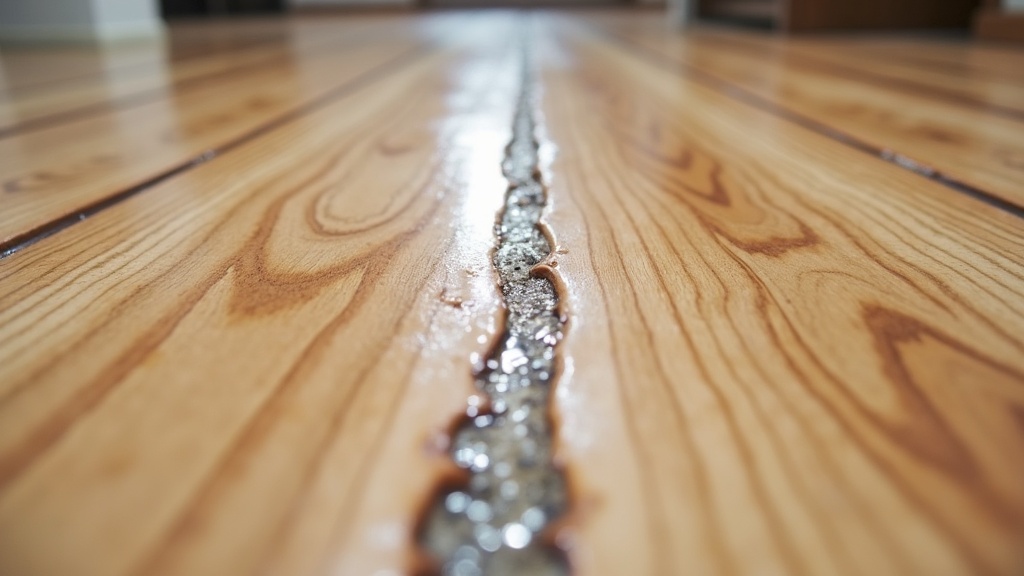
Because the plank is not the floor, and this is where the waterproof vs water resistant flooring argument stops being useful. A floating floor is a field of separate planks resting on a subfloor, and water that reaches the surface runs along it, finds the seams, and goes underneath.
Once it is under there, three things are true at once. The plank above is completely undamaged, exactly as promised. The subfloor beneath is wet. And the water has nowhere to evaporate to, because it is trapped between an impermeable floor above and a subfloor below.
Think of it like a raincoat with no hood. The jacket does its job perfectly and you still get wet, because the claim was never about the whole system.
This is why a burst supply line under a waterproof vinyl floor is still a subfloor problem, and why the flooring being undamaged is sometimes the reason the leak goes unnoticed for so long.
What actually contains water, rather than just surviving it?
Containment is a different engineering problem from survival, and only one common assembly is designed for it.
A tiled wet area is built over a bonded waterproof membrane, a sheet or liquid applied layer specified under ANSI A118.10, which is installed to carry water to a drain rather than to let it sit. In that assembly the tile and grout are the wearing surface and the membrane is the waterproofing. Treating tile and grout as the waterproof layer is one of the most common misunderstandings in a bathroom renovation, and one of the hardest to put right afterwards.
Everywhere else in a house, the realistic goal is not containment. It is buying time: enough time for someone to notice a spill and deal with it before anything underneath is affected. That is a perfectly reasonable goal, and it is what both waterproof and water resistant products genuinely deliver.
The practical rule that follows applies whatever floor you choose. Wipe spills promptly, put a mat under the dog bowl and the dishwasher, and treat any rated exposure window as a margin for error rather than a permission.
How should you read a manufacturer’s water claim?
Read past the headline word to the three things underneath it, because that is where the actual commitment lives.
- The exposure period. A water resistant product usually states a number of hours. That number is the claim, and the single word on the front of the box is only shorthand for it.
- The warranty exclusions. This is the most useful paragraph in the document. Standing water, flooding, plumbing failures and steam cleaning are commonly excluded, and an exclusion tells you precisely where the manufacturer believes the limit is.
- Whether the claim covers the installed floor or the plank. Almost always it is the plank. Some systems extend a claim to the installed floor where a specified underlayment, sealant or perimeter detail is used, and where that is offered, the specified detail is a condition rather than a suggestion.
A product that states a specific number of hours is being more honest with you than one that states a single confident adjective.
So which should you choose for a wet room?
Decide by how much water the room actually sees, rather than by the word on the sample.
- Shower floors and true wet rooms. Tile over a bonded waterproof membrane. This is the only common residential assembly built to contain water rather than tolerate it.
- Bathrooms, laundries and entries. A waterproof plank is a sensible choice, with attention to sealing at the perimeter and around fixtures where the manufacturer specifies it.
- Kitchens and hallways. Either a waterproof product or a sealed water resistant one, since the realistic risk is a spill noticed within minutes rather than standing water.
- Bedrooms and living rooms. Water performance is close to irrelevant. Choose on wear, feel and appearance instead.
Common mistakes
These are the errors this distinction causes most often.
- Reading a plank level claim as a floor level guarantee. The plank survives. The subfloor is a separate question.
- Using a waterproof floating floor in a shower. No floating floor is a wet area assembly, whatever the plank is made of.
- Assuming tile and grout are the waterproofing. They are the surface. The membrane underneath is the waterproofing.
- Ignoring the exposure window on a water resistant product, then leaving a spill overnight and treating the swelling as a defect.
- Skipping the perimeter sealing a manufacturer specifies, which is often the difference between a plank level claim and a floor level one.
- Steam cleaning a water resistant floor. Steam drives hot moisture into seams under pressure and is commonly excluded by name from the warranty.
- Choosing flooring for a basement on the water claim alone, without testing the slab for moisture coming up from underneath.
Frequently asked questions
The questions that come up most around waterproof vs water resistant flooring.
Is waterproof flooring genuinely waterproof?
The plank generally is. A vinyl plank contains no wood, so it can sit in water without swelling or coming apart, and that claim is true as stated. What it does not cover is the seams between planks, the subfloor beneath them or the walls around them, which is where water actually causes damage.
Can water resistant laminate go in a bathroom?
A family bathroom or powder room is usually within range for a sealed water resistant product, provided spills are dealt with rather than left. A shower floor is not, because that is a containment problem rather than an exposure one, and it calls for tile over a bonded membrane.
What happens to a waterproof floor if a pipe leaks under it?
The flooring is likely to be fine and the subfloor is likely not. Water spreads under a floating floor and stays there because it cannot evaporate through an impermeable surface, so the usual remediation is lifting the floor to dry what is underneath, even though the planks themselves can often be reinstalled.
Does waterproof flooring need underlayment?
Most rigid core products either have a pad attached or specify one, and adding a second layer beneath an attached pad is a common error that stresses the locking joints. Over concrete, a vapour retarder is frequently specified as well, which addresses moisture arriving from below rather than from above.
Is porcelain tile waterproof?
The tile itself is effectively impervious, absorbing 0.5 percent of its weight in water or less under ANSI A137.1. The grout between the tiles is porous unless it is epoxy, and the assembly beneath is what determines whether a tiled area actually contains water, which is why wet areas specify a bonded membrane.
Related reading
The material guides behind this comparison.
- Luxury vinyl plank, the product most often sold on a waterproof claim.
- Laminate flooring, where the water resistant claim and its exposure window come from.
- Tile flooring, and the assembly that genuinely contains water.
Not sure which claim a specific room actually needs? Contact us and we will help you think it through.
To get your project done right, click here for vetted local installers near you.
Sources
The standards behind the figures above.
- ANSI A137.1, specifications for ceramic tile, including water absorption classes
- ANSI A118.10, load bearing bonded waterproof membranes for thin set tile installation