Two numbers do most of the work
Put six luxury vinyl plank samples on a table and they will look remarkably alike. The printing has become good enough that the visual gap between an entry level product and a premium one is small, and the real difference sits in the construction, written on the box. Two specifications carry most of the decision.
- The wear layer, measured in mils. This is the clear film over the printed image, and it decides how long the floor keeps looking new.
- The core, which is either rigid or flexible. This decides how the plank feels, how it behaves over an imperfect subfloor, and how it responds to heat and sunlight.
Everything else, the colour, the embossing, the bevel, the plank size, is styling. Styling decides whether you like the room, not whether the floor still looks good in ten years.
The anatomy of a vinyl plank
A plank is a stack of thin layers, each with one job.
| Layer | What it is | What it decides |
|---|---|---|
| Coating | A urethane or ceramic bead top coat | Scuff and stain resistance, and how easily it cleans |
| Wear layer | Clear vinyl film, measured in mils | How long the printed image survives traffic |
| Print film | A photographic image of wood or stone | Everything you see, and nothing you feel |
| Core | Rigid composite or flexible vinyl | Dent resistance, sound, stability, subfloor tolerance |
| Attached pad | Optional foam or cork backing | Underfoot comfort and impact sound |
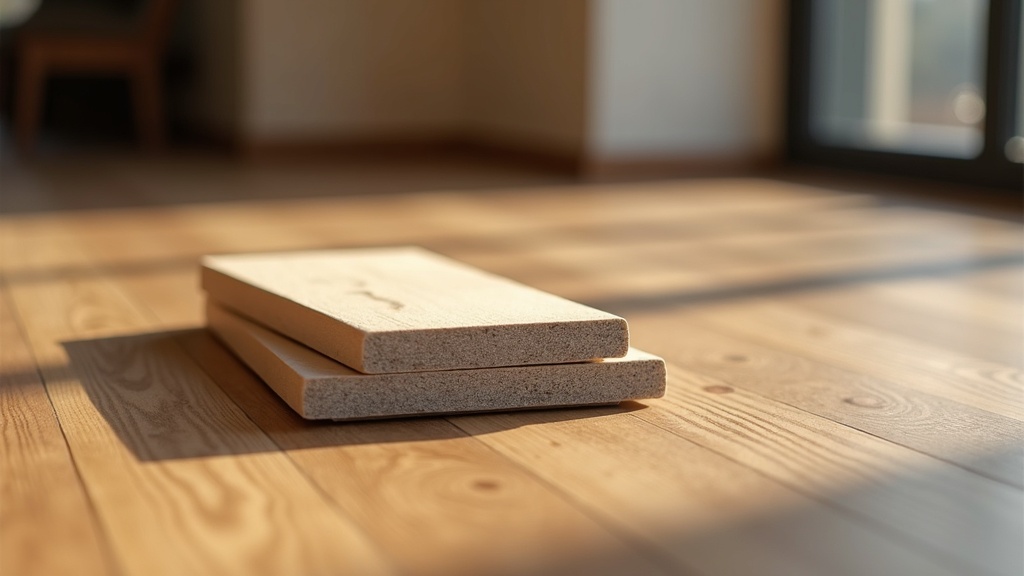
The wear layer, measured in mils and easily misread
A mil is one thousandth of an inch. That unit causes more confusion in flooring than any other, because it looks like a millimetre and is roughly forty times smaller. A 20 mil wear layer is about half a millimetre.
Manufacturers converged on a common set rather than a standardized one, so products cluster at 6, 12 and 20 mil, with 22 and 28 mil in commercial ranges. As a working rule, 6 mil suits a spare bedroom, 12 mil is the default for a family home, and 20 mil is what you want for a hallway, an entry, a rental, or a house with a large dog. Once the wear layer is gone the printed image goes with it, and there is no refinishing a vinyl floor.
Think of it as tread on a tire. Nothing about the tire improves as the tread wears, and when the tread is gone the tire is finished however good the sidewall looks.
Choose 20 mil when the room is busy or the floor has to last through tenants, and 12 mil when the traffic is ordinary and the budget is better spent on a thicker core.
Rigid cores: the difference between SPC and WPC
Most luxury vinyl plank sold today has a rigid core, in one of two families.
Stone plastic composite, or SPC, is a dense core of limestone powder and PVC. It is hard, thin and the most dimensionally stable of the three, which suits a sunroom or any space that swings between hot and cold. The density is the trade off: louder underfoot, harder on the feet, and it spans dips in the subfloor rather than following them.
Wood plastic composite, or WPC, uses a foamed core instead. It is thicker, warmer, softer and noticeably quieter, and its compressibility absorbs small variations in the subfloor that a rigid core would simply span. In exchange it dents more easily under a heavy point load such as a piano leg or a fridge, and it is more sensitive to prolonged direct sun.
Two failures get muddled together here, and they belong to different products. A stiff core spans a dip instead of following it, leaving an unsupported void: that is bridging, and you hear it as a hollow spot before you feel it as a stressed joint. A thin flexible plank does the opposite, following the substrate so faithfully that a ridge or a screw head reads through to the surface: that is telegraphing, and you see it rather than hear it. WPC sits between those two ends: rigid enough to lock and float like SPC, compressible enough to take up small irregularities instead of spanning them, which is why it is quieter and why it dents more easily.
Choose SPC when the room gets strong sunlight or heavy furniture, and WPC when comfort and quiet matter more, such as a bedroom or a room above another living space.
Flexible glue down vinyl, the older sibling
Before rigid cores existed, luxury vinyl was a thin flexible plank glued directly to the subfloor. It is still made, still specified heavily in commercial work, and still the right answer in some homes.
Glue down planks are typically 2 to 3 mm thick, and the same wear layer scale applies: the mil figure still decides longevity, which is why commercial specifications commonly start at 20 mil. Because these planks conform to whatever is underneath rather than resisting it, they demand a flatter, better prepared subfloor. Get that right and the result is the most solid and quiet vinyl floor available, with no hollow sound and no movement, and it is the easiest to repair one plank at a time.
Choose glue down when the subfloor is flat and sound and you want the most solid feel, and a floating rigid core when the substrate is less than perfect.
What waterproof actually covers
This is the most oversold word in flooring, and the honest version is the more useful one. The plank genuinely is waterproof: it can sit in a puddle indefinitely without swelling, delaminating or coming apart, which is a real difference from wood or laminate. That claim is about the plank, and it is true.
The floor is a different matter. Water that reaches a floating floor runs through the seams, sits on the subfloor, and has nowhere to evaporate to. The plank survives; the plywood below it may not. That is why a burst supply line under a vinyl floor is still a subfloor problem, and why a wet room is still tiled over a bonded membrane. Read the claim as: spills, wet boots and a dishwasher leak caught quickly are not a crisis, the assembly is not sealed, and this is not a shower floor.
What else is on the spec sheet
Wear layer and core type decide the floor. Four other lines are worth a glance and no more. Total thickness, commonly 4 to 8 mm, sets your door clearance rather than your durability. An attached pad replaces separate underlayment rather than adding to it. A FloorScore certification means the product has been tested for indoor air emissions. And the warranty is worth reading for what voids it, because sunlight and installation method are the two usual exclusions.
How luxury vinyl plank is installed
Rigid core planks float. They click to each other, rest on the subfloor, and are held down by nothing but their own weight, which means they need room to move. A perimeter expansion gap is left around every wall and every fixed object, and it is covered by trim rather than filled.
Flatness still matters, even though vinyl is more forgiving than tile. A tolerance of about 3/16 of an inch over ten feet is the usual benchmark, taken from the ASTM F710 practice for preparing concrete to receive resilient flooring, and rigid cores are stricter about it than foamed ones because they bridge rather than conform.
Over concrete, vinyl tolerates slab moisture far better than wood, but a moisture test is still standard practice, usually an in situ relative humidity test to ASTM F2170.
Over a wood subfloor, the more common case in a house, the work is mechanical rather than chemical: loose sheets refastened, popped nails set or replaced with screws, high spots sanded, low spots filled with patching compound. Rigid planks are unforgiving of a springy deck because they will not follow it.
Two things a condominium changes
Above the ground floor, two constraints appear that a house never imposes.
The first is sound. Model building codes across North America set a minimum impact insulation class of 50 for the assembly between dwelling units, measured to ASTM E492, and individual buildings often set their own higher figure. The rating belongs to the whole floor and ceiling assembly rather than to the plank, so a manufacturer’s IIC number is only meaningful for the test build up it was measured in. Getting written approval before purchase avoids lifting a floor afterwards.
The second is radiant heat, which is common under vinyl and works well because the planks are thin. The constraint is surface temperature rather than the system, and manufacturers commonly cap it at around 27 degrees Celsius in their installation instructions, with the system brought up gradually at the start of the season. SPC is the more dimensionally stable of the two through that cycling, and any product used over radiant heat should state that it is rated for it, because not all are.
Common mistakes
Every one of these is decided before the first plank is cut.
- Confusing mils with millimetres. A 20 mil wear layer is about 0.5 mm, and any figure quoted in millimetres is total thickness, a different specification entirely.
- Buying total thickness instead of wear layer. An 8 mm plank with a 6 mil wear layer will look worn long before a 5 mm plank with 20 mil.
- Treating waterproof as a guarantee about the whole floor. The plank is waterproof, the assembly is not, and the subfloor underneath is still vulnerable.
- Adding underlayment beneath a plank that already has an attached pad. Two layers of cushion gives too much and stresses the locking joints.
- Leaving no expansion gap, or trapping the floor under heavy built in cabinetry, then finding a ridge across the room in the first warm spell.
- Putting a foamed core under a sunny window and finding dents where the furniture sits.
- Reading rigid as forgiving. Rigid means it bridges hollows rather than following them, which is exactly what creates a hollow sound.
Frequently asked questions
These come up in almost every conversation about vinyl.
What wear layer do I need if I have a dog?
Twenty mil for a large dog or several animals, and 12 mil is usually adequate for a small dog in a quiet home. Claw damage is a scratch through the wear layer, so thickness is the entire defence, and a textured surface hides what gets through.
Is 20 mil the same as 20 mm?
No, and the difference is enormous. A mil is one thousandth of an inch, so a 20 mil wear layer is about 0.5 mm. Any flooring described as 20 mm thick is quoting total plank thickness, which no residential vinyl plank reaches.
What is the difference between LVP and LVT?
Only the shape and the pattern printed on it. Plank imitates wood, tile imitates stone, and the construction underneath is identical.
Can luxury vinyl plank be installed in a bathroom?
Yes, and it is a common choice for a family bathroom or powder room, because splashing and steam will not damage the plank. A shower floor is a different problem needing tile over a bonded membrane, because that assembly has to contain water, not merely shed it.
Can vinyl plank go over an existing floor?
Often yes, over one layer of sound, well bonded, flat material such as tile or sheet vinyl, provided the height still works at doorways. Not over carpet, and not over anything loose, cupped or hollow, because a floating floor copies whatever it rests on.
How long does a vinyl plank floor last?
The floor ends when the wear layer does, because there is no way to renew the surface once the print is exposed. The most checkable proxy is the residential wear warranty, which commonly runs fifteen to twenty five years on a thick wear layer and considerably shorter on a thin one. A warranty term is a claim about wear under normal use rather than a prediction of service life, but the gap between two products’ terms is a fair guide to the gap between the products.
Related reading
If vinyl is on your shortlist, these three sit next to it.
- Flooring types explained, the overview of all six common floors and where each belongs.
- Laminate flooring, the product vinyl is most often confused with.
- Engineered hardwood, for when you want a real wood surface over a slab.
Trying to choose between vinyl and another material for a specific room? Contact us and we will help you think it through.
To get your project done right, click here for vetted local installers near you.
Sources
The standards and references behind the figures above.
- ASTM F710, standard practice for preparing concrete floors to receive resilient flooring
- ASTM E492, laboratory measurement of impact sound transmission through floor and ceiling assemblies
- ASTM F2170, in situ relative humidity testing of concrete floor slabs
- FloorScore indoor air quality certification, administered under the SCS Global Services program