Why the layers underneath decide almost everything
The surface of an engineered hardwood floor is genuine hardwood, cut from the same species as a solid plank. Once it is installed and finished, nobody can tell the two apart by looking. That is the whole point of the product, and it is also why comparing two engineered floors by appearance tells you almost nothing useful.
What separates a floor that still looks good in thirty years from one that looks tired in eight sits underneath the surface. Three questions settle most of the decision, and they are worth asking in this order.
- How thick is the wear veneer? This decides whether the floor can ever be sanded and refinished, or whether the surface you buy is the surface you keep.
- What is the core made of? This decides how the plank behaves over concrete, over radiant heat, and through a dry winter with the furnace running.
- How is it joined and finished? This decides which installation methods are open to you, and how the surface behaves day to day.
Species, colour, plank width and texture come after those three. They decide how the room looks. They have very little to do with how the floor performs.
The anatomy of an engineered plank
Every engineered board is a stack, and each layer in the stack has one job.
| Layer | What it is | What it decides |
|---|---|---|
| Finish | A cured coating, usually urethane with aluminum oxide | Scratch and abrasion resistance |
| Wear veneer | Real hardwood, sliced or sawn from the log | Whether the floor can be refinished, and how many times |
| Core | Plywood, high density fibreboard, or a rigid composite | Stability, moisture tolerance, and how it can be installed |
| Balancing layer | A backing sheet under the core | Keeps the plank from cupping as humidity changes |
| Edge profile | Click locking, tongue and groove, or square edge | Installation method and how the seams read |
The wear veneer: the number that decides if it can ever be sanded
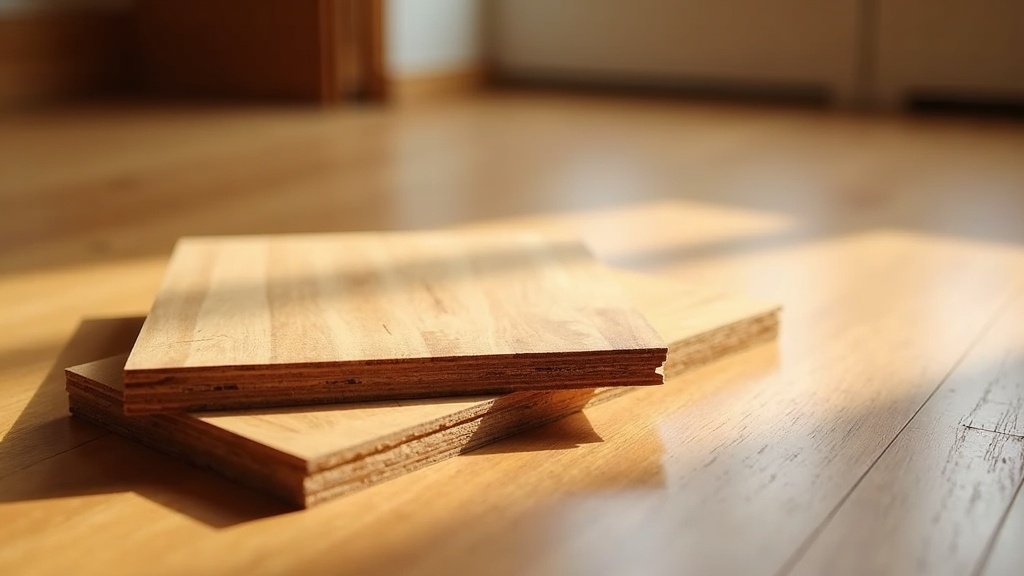
Wear veneer is the layer of real wood above the core, and it is commonly anywhere from 0.6 mm to 6 mm. That range is enormous in practice, because a full sanding removes roughly 1 mm of material. A veneer of about 2 mm can generally take one careful sanding. Around 3 mm and up allows more than one. Under roughly 1 mm, refinishing is off the table permanently, and the floor becomes something you maintain rather than renew.
None of this makes a thin veneer a bad product, it makes it a different product with a different lifespan. A thin veneer floor in a spare bedroom may never need sanding in the time you own the house. The same floor in a hallway with a dog and two children is a replacement in a decade.
There is a middle option. A screen and recoat abrades only the finish and adds a fresh coat without touching the wood. It refreshes a dull floor, does nothing for deep scratches, and can be done on almost any veneer thickness.
Choose a thicker veneer when you expect to keep the floor through more than one phase of the house, and a thinner one when the room is quiet and the budget is better spent elsewhere.
The core: plywood, fibreboard, or a composite
The core is what makes engineered wood engineered. Layers are cross laminated so the grain of each runs against its neighbour, and that opposition counters the seasonal movement that makes solid planks cup and gap.
Plywood cores, typically five to nine plies of birch or poplar, are the all round choice. They hold fasteners, so a plywood core plank can often be nailed or stapled as well as glued or floated, and they behave predictably over a wood subfloor.
High density fibreboard cores are harder and flatter than plywood and hold a click locking profile crisply, which makes them common in floating installations. They are also less forgiving of standing water, because the same density that makes them stable makes swelling permanent once it happens.
Rigid composite cores, the same family of material used in rigid vinyl planks, are newer to real wood products, are the most dimensionally stable of the three, and are almost always floated. Whatever the core, composite wood sold in North America is regulated for formaldehyde emissions under California Air Resources Board Phase 2 and the federal EPA TSCA Title VI rule, and reputable products state compliance on the box.
Choose a plywood core when the floor is going over a wood subfloor and you want the widest range of installation options, and a fibreboard or composite core when you are floating a floor over concrete and flatness matters most.
Species, finish and the parts you actually see
Species sets the grain, the colour range and the hardness. Hardness is measured on the Janka scale, which presses a steel ball into the wood and reports the force required. Red oak sits at about 1,290 lbf and is the reference other species are judged against, white oak is roughly 1,360, hard maple around 1,450, hickory near 1,820, and American walnut about 1,010, which is why walnut is prized for its colour and marks more easily.
Most engineered hardwood arrives factory finished, with several coats of UV cured urethane carrying aluminum oxide. That finish is harder than anything applied on site, and it arrives with no dust and no drying time. Site finishing costs days and mess, and in exchange gives a continuous surface with no bevels between boards and lets colour be matched to existing floors.
Texture matters more than most people expect. A wire brushed or hand scraped surface hides small scratches and everyday wear, while a smooth high gloss surface shows every one, in the same way a gloss black car shows swirls the matte version hides.
Choose a harder species and a textured finish when the room is busy, and take the softer species or the smoother sheen when the room is calm and the look is what you are buying.
How to read an engineered hardwood spec sheet
Five numbers carry nearly all of the information. The rest of the sheet is description.
| Spec | What it means | What to look for |
|---|---|---|
| Wear veneer thickness | Real wood above the core | About 2 mm to sand once, 3 mm or more to sand again |
| Core construction | What counters seasonal movement | Plywood for versatility, fibreboard or composite for flatness |
| Total thickness | Overall board height | Commonly 3/8 to 3/4 inch, which sets your door and transition heights |
| Finish system | Abrasion resistance of the surface | UV cured urethane with aluminum oxide, and the number of coats |
| Emissions compliance | Formaldehyde from the composite core | A stated CARB Phase 2 or EPA TSCA Title VI compliance |
Warranties are worth separating into two numbers. A structural warranty covering delamination is often twenty five years or more, while the finish warranty, the one you are far more likely to use, is frequently much shorter. They are two different promises.
How engineered hardwood is installed
There are three methods, and the product plus the subfloor decides which are available.
- Floating. Planks lock to each other and rest on an underlayment, touching nothing. Fast, forgiving, and slightly hollower underfoot.
- Glue down. The plank is adhered to the subfloor, which gives the most solid feel and the quietest result. It is the usual specification over concrete.
- Nail or staple down. Traditional, and available when the core holds fasteners and the subfloor is wood.
Two preparation steps decide more than the method does. The subfloor has to be flat, and the National Wood Flooring Association’s commonly cited tolerance is about 3/16 of an inch over ten feet. And over concrete the slab is tested for moisture first, using in situ relative humidity probes to ASTM F2170 or a calcium chloride test to ASTM F1869, because concrete that looks dry can still emit enough moisture to fail an adhesive.
Acclimation is the third step people skip. Wood is left in the room it will live in so it reaches the moisture content it will hold in service, commonly for three to five days, though the manufacturer’s instruction governs and some modern products specifically say not to acclimate. Over radiant heat, the limit is surface temperature, and around 27 degrees Celsius is a typical ceiling. An installer who treats flatness, moisture testing and acclimation as non negotiable is telling you something useful about how the rest of the job will go.
Common mistakes
These come up constantly, and each one is avoidable in the showroom.
- Buying on total thickness. A 3/4 inch plank with a 0.6 mm veneer can never be sanded. A 1/2 inch plank with a 3 mm veneer can be sanded twice. Total thickness answers a doorway question, not a longevity one.
- Assuming engineered means waterproof. It is real wood over a wood based core, more dimensionally stable than solid hardwood and still not a floor for a wet room. Standing water gets wiped up promptly whatever the product.
- Skipping the slab moisture test. This is the single most common cause of adhesive failure and cupping over concrete, and the test is cheap compared to the floor.
- Reading only the headline warranty. The structural number is long and rarely claimed. The finish number is the one that matters day to day.
- Installing straight off the truck, then blaming the product when gaps appear in the first heating season.
- Choosing a high gloss smooth finish for a hallway. It looks superb for a month and shows every scuff after that.
- Forgetting height at doorways. Build up changes transitions, can stop a door closing, and is a great deal harder to solve once the floor is down.
- Ordering short. A waste allowance around 10 percent is normal for a straight layout and more for diagonal or herringbone work, and boards from a later production run will not match.
Frequently asked questions
These are the questions that come up most once people start comparing specific products.
Can engineered hardwood be refinished?
Yes, if the wear veneer is thick enough. A full sanding removes roughly 1 mm, so about 2 mm allows one refinish and 3 mm or more allows two or three. Below roughly 1 mm, a screen and recoat of the finish is the only option available.
Is engineered hardwood real wood?
The surface is real hardwood, and it is the same material as the top of a solid plank. What differs is the construction underneath, where a cross laminated core replaces solid wood to counter seasonal movement.
Can engineered hardwood go in a basement?
Usually yes, and it is the standard choice when someone wants a real wood surface below grade. The conditions are a slab moisture test that passes, a vapour retarder where the manufacturer requires one, and indoor humidity kept in a reasonable band year round.
How long does an engineered hardwood floor last?
With a veneer of 3 mm or more and normal care, twenty to thirty years is reasonable, and refinishing extends that. Under 1 mm, ten to fifteen years is more realistic before the surface looks worn, because there is no way to renew it.
Which is more stable, engineered or solid hardwood?
Engineered, by a clear margin, because the cross laminated core opposes the expansion and contraction that makes solid planks cup in humid months and gap in dry ones. That is why it dominates over concrete, over radiant heat and in apartments.
Does engineered hardwood work over radiant heat?
Most products do, and it is one of the main reasons the category exists. The limit is surface temperature rather than the heating system itself, and around 27 degrees Celsius is a common maximum. Slow, staged warm up at the start of the heating season also reduces movement.
Does plank width change anything?
It changes how visible seasonal movement is. Wider boards move more across their width than narrow ones, so a 7 inch plank shows a season of dry indoor air more obviously than a 3 inch plank of the same species and construction.
Related reading
Three companion guides, if you are still narrowing the field.
- Flooring types explained, the overview of all six common floors and where each belongs.
- Luxury vinyl plank, the usual alternative when moisture rules out wood.
- Laminate flooring, which looks similar and is built completely differently.
Weighing engineered hardwood against another material for a specific room? Contact us and we will help you think it through.
To get your project done right, click here for vetted local installers near you.
Sources
The standards and references this guide draws on.
- National Wood Flooring Association, installation guidelines and moisture guidance
- ASTM F2170, in situ relative humidity testing of concrete floor slabs
- ASTM F1869, anhydrous calcium chloride moisture vapour emission testing
- California Air Resources Board Phase 2 and EPA TSCA Title VI, composite wood formaldehyde standards
- Janka hardness reference values for North American species