One fact explains everything about it
Solid hardwood flooring is a plank milled from a single piece of wood, traditionally 3/4 of an inch thick, with nothing underneath it but more of the same wood. That one sentence explains both why the material has lasted three centuries and every awkward thing about living with it.
Because it is solid all the way down, there is material to remove, which is why a hardwood floor can be sanded back to bare wood and refinished again and again. Original floors in century old houses are usually not survivors of good luck. They are floors that were renewed four or five times.
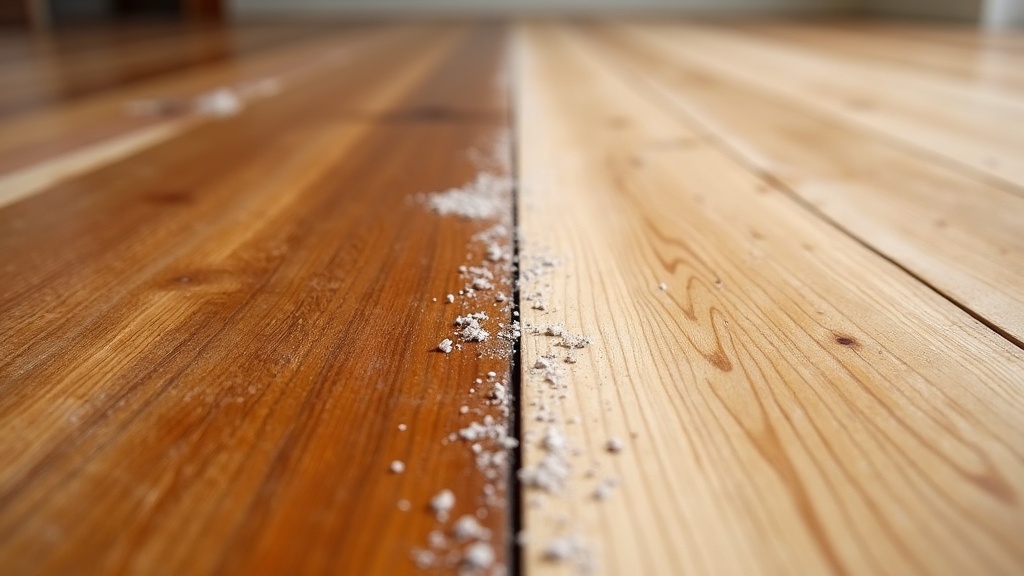
And because it is wood, it moves. Wood takes on moisture from the air and gives it back, swelling across the grain in humid months and shrinking in dry ones. Every rule about where solid hardwood belongs, how it is installed and what goes wrong with it traces back to that movement.
Read the rest of this guide with those two consequences in mind. They are not separate features. They are the same fact, seen from two directions.
How many times can a hardwood floor be refinished?
A full sand and refinish removes roughly 1/32 of an inch of wood, and a 3/4 inch plank has about 1/4 of an inch of usable material above the tongue. Think of that quarter inch as a budget the floor spends about a thirty second of an inch at a time.
On paper that is eight passes. The figure usually quoted in the trade is four to six, and the gap between the two is where real floors live. A heavy handed sanding takes more than a thirty second. Sanding to remove deep damage, rather than to renew a tired finish, takes a bigger bite again. And the last pass or two get cautious as the tongue gets close. Treat eight as the ceiling and four to six as what actually happens.
There is a lighter option that most people do not know exists. A screen and recoat abrades only the finish and lays down a fresh coat, leaving the wood untouched. It renews a dull, scuffed floor in a day, does nothing for scratches that reach the wood, and costs none of the refinishing budget. A floor that gets recoated every decade may never need a full sanding at all.
Where does solid hardwood belong, and where does it not?
Solid hardwood belongs above grade, over a wood subfloor, in a room with reasonably stable humidity. That is the short answer, and each part of it is about movement rather than about water damage in the dramatic sense.
Below grade means below the surrounding ground level, and a basement is the usual case. Slabs pass moisture upward continuously, and solid planks fastened over that will cup. This is the single most common reason a homeowner is steered toward engineered wood instead, and it is not a downgrade so much as a different tool.
Humidity matters more than people expect, and the target is a range rather than a number. The National Wood Flooring Association’s guidance is to keep interior conditions in the range wood was manufactured and acclimated to, commonly 30 to 50 percent relative humidity. Homes that swing far outside that band, in either direction, will show it in the floor: gaps between boards in a dry winter, tight boards and cupping in a humid summer.
The practical version, and it applies whatever floor you end up with: run a humidifier or a dehumidifier as the season demands, and keep the house in a steady band rather than chasing a perfect number.
What the grade on the box actually describes
Hardwood is graded for appearance, not for strength. The National Hardwood Lumber Association grading rules separate boards by how much colour variation, knot and mineral streak they contain, and a lower grade is not a weaker floor. It is a busier looking one.
| Grade | What you see | Suits |
|---|---|---|
| Clear | Very uniform colour, almost no knots | Formal rooms, a calm and consistent look |
| Select | Mostly uniform, small knots and some variation | The common middle choice |
| Number 1 Common | Noticeable colour variation, knots, longer boards mixed with short | Character floors, rustic rooms |
| Number 2 Common | Strong variation, more knots and mineral streaking | Deliberately rustic work, cabins, budget conscious projects |
This is worth knowing because it is the specification most often mistaken for quality. A Number 1 Common oak floor and a Clear oak floor are the same wood, the same thickness and the same lifespan. They look different, and what separates them is the scarcity of uniform boards rather than durability.
Species, hardness, and what the Janka number tells you
Species sets the grain, the colour range and the hardness. Hardness is measured on the Janka scale, which presses a steel ball halfway into a sample and reports the force required in pounds force.
Red oak sits at about 1,290 lbf and is the reference point most other species are described against. White oak is roughly 1,360, hard maple around 1,450, hickory near 1,820, and American black walnut about 1,010, which is why walnut is prized for its colour and marks more readily than the oaks.
Read the Janka number as one input rather than a verdict. It describes resistance to indentation under a specific laboratory test, not how a floor will look after ten years in your hallway. Finish, sheen and grain pattern do more to hide everyday wear than a couple of hundred Janka points will. A wire brushed or matte floor in a softer species often looks better at year five than a glossy floor in a harder one.
Site finished or factory finished?
Both arrive as bare or coated 3/4 inch planks, and the difference is where the finish goes on. That choice affects how the floor looks, how long the job takes and what happens years later.
A factory finished floor is coated in a controlled plant, usually with several coats of UV cured urethane carrying aluminum oxide, then micro bevelled at the edges. It is walked on the same day it is laid, there is no dust and no curing smell, and the bevels give the floor a defined plank by plank look.
A site finished floor is laid raw, then sanded flat and coated in place. The result is a continuous surface with no bevels, which reads as one plane of wood rather than a set of boards, and colour can be matched to an existing floor. The costs are days of disruption, dust, and a curing period before furniture returns.
Neither is the better answer in general. Factory finish suits a household that needs the room back quickly. Site finish suits a whole floor renovation where the seamless look is the point, or where new work has to disappear into old.
How solid hardwood is installed
Solid planks are nailed or stapled down through the tongue into a wood subfloor. That fastening is what distinguishes the installation from the floating and glue down methods used for most other materials, and it is why a wood subfloor is a precondition rather than a preference.
Three preparation steps decide most outcomes, and an installer who treats all three as non negotiable is telling you something useful about the rest of the job.
- Moisture testing. Both the wood and the subfloor are metered before anything is fastened. The National Wood Flooring Association’s guidance is that the difference between them should be within 4 percent for strip flooring under 3 inches wide, and within 2 percent for wider planks, because a wide board magnifies whatever movement follows.
- Acclimation. The wood is delivered and left in the room it will live in, under normal working conditions, until its moisture content settles into that range. This is a measurement, not a fixed number of days, which is why a good installer arrives with a meter rather than a calendar.
- Expansion space. A gap is left at every wall and fixed obstruction so the floor has somewhere to go when it swells, covered by trim rather than filled.
Board width changes the stakes on all three. A 5 inch plank moves more across its width than a 2 1/4 inch strip of the same species at the same moisture change, so wide plank floors are less forgiving of a rushed acclimation.
Common mistakes
These come up repeatedly, and every one of them is decided before the floor is finished.
- Putting it below grade. A basement is the wrong room for solid wood however good the product is, and engineered hardwood exists precisely for that case.
- Reading a grade as a quality ranking. Number 1 Common is an appearance grade, not a lesser floor.
- Choosing by Janka number alone, then being surprised that a hard species still shows scratches. Janka is measured by pressing a steel ball into a sample in a laboratory, which is a different question from how visible a scratch is on a finished floor. Finish, sheen and grain do the hiding.
- Installing to a calendar instead of a meter. Wood that has not reached equilibrium will move after it is fastened, and the gaps show up in the first heating season.
- Letting indoor humidity swing across the seasons, then blaming the floor for the gapping that follows.
- Skipping the expansion gap, or fitting trim hard against the boards so the floor is pinned.
- Ordering exactly the measured area. A waste allowance around 10 percent is normal for a straight layout, more for diagonal or herringbone work, and boards from a later production run will not match.
- Sanding at the first sign of dullness. A screen and recoat often solves it and costs none of the floor’s refinishing budget.
Frequently asked questions
These are the questions that come up most once solid hardwood is on the shortlist.
How long does solid hardwood flooring last?
Longer than most other components of the house. With refinishing, a service life measured in many decades is normal, and hundred year old floors still in use are common in older housing stock. The limit is not wear, it is how much material remains above the tongue after repeated sandings.
Can solid hardwood go over concrete?
It is not the standard approach. Concrete passes moisture upward, and solid planks cannot be nailed to a slab in any case, so the usual answer over concrete is engineered hardwood. Where solid wood over a slab is attempted, it requires a plywood subfloor system and a vapour retarder, which is a specialist installation rather than a routine one.
Is solid hardwood better than engineered?
Neither is better in the abstract, and they answer different questions. Solid gives the longest renewable life and needs a dry, above grade room with a wood subfloor. Engineered gives a real wood surface in places solid wood should not go, including over concrete and radiant heat, at the cost of a finite veneer.
Why does a hardwood floor gap in the winter?
Because heated indoor air in cold weather is dry, the wood gives up moisture and shrinks across its width. Thin seasonal gaps that close again in summer are normal behaviour rather than a defect. Gaps that do not close, or that appear in the first months after installation, usually point to wood that was fastened before it reached equilibrium.
Does plank width matter?
It changes how visible seasonal movement is. A wide board moves more across its width than a narrow one under the same conditions, so a 5 inch plank shows a dry winter more obviously than a 2 1/4 inch strip. Wide plank floors reward careful moisture work and stable indoor humidity.
What is the hardest wood flooring species in common use?
Among widely available North American species, hickory is the hardest at roughly 1,820 lbf on the Janka scale, ahead of hard maple at about 1,450 and the oaks in the 1,290 to 1,360 range. Several imported species test considerably higher, though availability and colour usually decide those choices rather than the number.
Related reading
Three guides that sit alongside this one.
- Flooring types explained, the overview of all six common floors and where each belongs.
- Engineered hardwood, the answer when you want real wood somewhere solid wood should not go.
- Laminate flooring, for how a wood look is achieved without wood.
Weighing solid hardwood against engineered for a specific room? Contact us and we will help you think it through.
To get your project done right, click here for vetted local installers near you.
Sources
The authorities this guide draws on.
- National Wood Flooring Association, installation guidelines and moisture and humidity guidance
- National Hardwood Lumber Association, hardwood grading rules
- Janka hardness reference values for North American species