Rated, not measured, and that is the useful part
Every other common floor asks you to compare a measurement. Vinyl gives you a wear layer in mils. Engineered wood gives you a veneer in millimetres. Laminate flooring does something different: it gives you a class, produced by a standardized abrasion test, and that class is a better predictor of real world performance than any thickness on the box.
That is why two boards that look identical, and are both described as durable, can belong in completely different rooms. The rest follows from one sentence of construction: laminate is a photograph, sealed under a hard plastic shell, bonded to a compressed wood core. Every strength and the single weakness come directly from that description.
What laminate is actually made of
Four layers, pressed together under heat and pressure into a single board.
| Layer | What it is | What it decides |
|---|---|---|
| Wear layer | Clear melamine resin, usually carrying aluminum oxide | Scratch and abrasion resistance, and the AC class |
| Decor layer | A high resolution printed paper | Everything you see |
| Core | High density fibreboard, compressed wood fibre and resin | Strength, impact resistance, and behaviour around water |
| Backing | A balancing layer, sometimes with an attached pad | Keeps the board flat and slows moisture uptake from below |
The wear layer is where laminate earns its reputation. Aluminum oxide is among the hardest materials used in any flooring finish, and the AC class exists precisely so that abrasion performance is measured rather than asserted. The core is where the limitation lives. The two facts are not in tension; they are about different parts of the board.
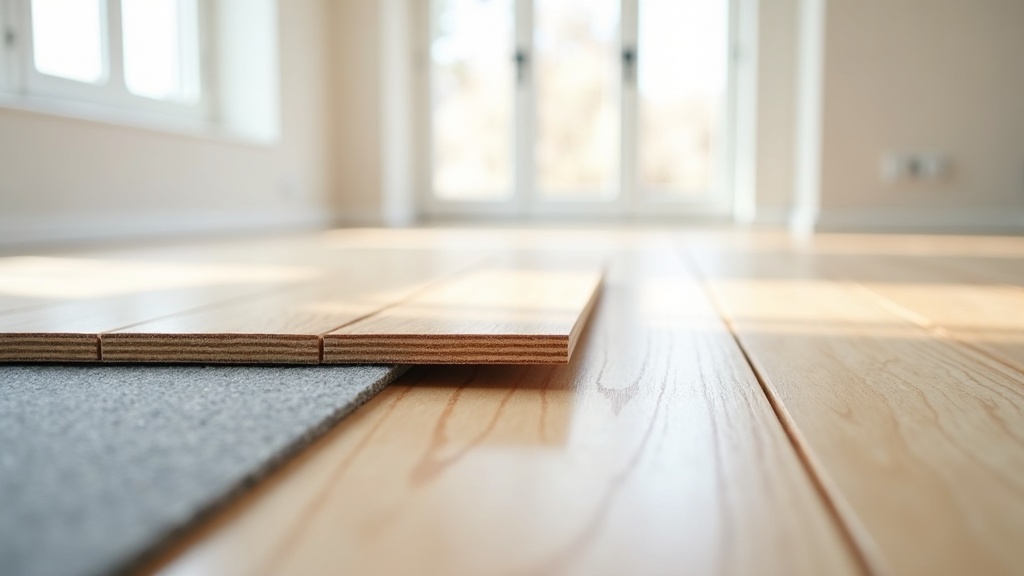
The AC rating: what the classes actually mean
AC stands for abrasion class, and it comes from the European standard EN 13329. The test is mechanical rather than subjective. A sample is abraded with a loaded rotating pad and the number of revolutions before the print begins to break down determines the class. Because the test is standardized, an AC4 board from one manufacturer is genuinely comparable with an AC4 board from another.
| Class | Intended use | In practice |
|---|---|---|
| AC1 | Light residential | Bedrooms and rooms with very little traffic |
| AC2 | General residential | Living areas in a quiet household |
| AC3 | Heavy residential, light commercial | The sensible minimum for a whole home, including kitchens and hallways |
| AC4 | General commercial | Busy family homes, entries, rentals, small offices |
| AC5 | Heavy commercial | Retail and public spaces, and more than most homes require |
The guidance is simpler than the table looks. AC3 is the minimum worth putting in a house you live in, AC4 is the one to choose wherever there is an outside door, a pet or tenants, and AC5 is specified for shops and is rarely necessary at home.
Water resistant is not waterproof, and the core is why
This is the honest limitation of the material, and it is better understood than glossed over.
The surface of a laminate board sheds water completely. The melamine wear layer is impermeable and a spill can sit on it for hours without leaving a mark. The core is the vulnerable part. High density fibreboard is wood fibre squeezed under enormous pressure into a dense board, and it behaves like compressed cardboard: soak it and it swells, dry it out and it never returns to the shape or the density it started with. That swelling shows up as a raised, roughened lip along the seams, and drying the floor out does not reverse it.
Water resistant laminate addresses this properly rather than cosmetically. Manufacturers use a denser, resin heavy core, seal the board edges with wax or a coating, and tighten the locking profile so water is far slower to reach the core through the seams. Products are then commonly rated for a period of surface exposure, often 24 or 72 hours, after which the water needs to be gone.
That is a different claim from the one vinyl makes. A vinyl plank does not care how long water sits on it, because there is no wood in it. A water resistant laminate is buying you time to notice and mop up, which is enough for a kitchen, a hallway or a laundry, and is not enough for a shower floor.
Why laminate cannot be renewed
There is no wood veneer on a laminate board, so there is nothing to sand. When the wear layer finally gives up and the printed decor layer starts to show through, usually first in a traffic lane or in front of a sink, that section of floor is finished. Refinishing is not an option, and coatings applied later do not bond well to melamine.
That is not a criticism, it is a planning fact, and it has one practical consequence: keep a box of spare boards from the original production run. A single damaged board can be swapped out, and a later dye lot will not match.
Thickness is the specification most often mistaken for quality
Boards commonly run from 7 to 12 mm, and it is tempting to read that number as durability. It is not. Scratch and wear resistance is the AC class doing the work, and a 12 mm AC2 board will wear through before an 8 mm AC4 board does.
What thickness actually buys is rigidity, a deeper and stronger locking profile, a more solid footfall, and less of the hollow sound that gives a cheap floor away. Those are real benefits and they are acoustic and structural rather than about lifespan. The other line worth checking is emissions compliance, since the core is a composite wood product: reputable boards state conformity with California Air Resources Board Phase 2 or the federal EPA TSCA Title VI rule.
How laminate is installed
Laminate is a floating floor. The boards lock to each other and rest on an underlayment, fastened to nothing, which is what makes it quick to install and what makes the preparation underneath so decisive. The field of the floor is never glued or nailed down, though the trim around it is: stair nosings, thresholds and some transition profiles are still mechanically fixed, and they have to be, because those are the points that take the abuse.
- Flatness. A tolerance around 3/16 of an inch over ten feet is the figure the North American Laminate Flooring Association publishes. A floating floor spans hollows rather than following them, and every hollow becomes a soft spot, a click, or eventually a failed joint.
- Underlayment. It provides cushioning, sound reduction and, over concrete, a vapour barrier. Where a pad is already attached to the board, a second layer is not added.
- Expansion gap. Usually 1/4 to 3/8 of an inch around every wall, pipe and fixed object, hidden by trim rather than filled with anything.
- Acclimation. Boxes are commonly left flat in the room for 48 hours or more so the boards reach the conditions they will live in.
Radiant heat is compatible with most laminate, and the constraint is the same one that applies to wood: surface temperature, not the heating system. Around 27 degrees Celsius is the usual ceiling, the system is brought up slowly at the start of the season rather than switched straight to full output, and a low resistance underlayment is used so the heat actually reaches the room. Electric mats and hydronic systems both work within those limits.
The expansion gap causes the most avoidable failures. A floating floor grows and shrinks as one large sheet, so pinch it at a doorway, trap it under a kitchen island built on top of it, or run it too far without a transition, and it has nowhere to go but up. The buckle then appears in the middle of the room, a long way from its actual cause.
Common mistakes
These account for most laminate complaints, and none of them are the product failing.
- Treating water resistant as waterproof. The claim is a period of surface exposure, not immunity, and the core swells permanently once it is wet.
- Adding underlayment beneath a board that already has a pad attached, which creates too much movement and stresses the joints.
- Skimping on the expansion gap, or fitting trim tight to the floor so the boards are clamped in place.
- Installing heavy cabinetry or a kitchen island on top of a floating floor, which pins it at one point and forces movement elsewhere.
- Wet mopping, and steam mopping above all. Steam drives hot moisture into the seams under pressure, which is the fastest way to swell a core and lift a wear layer. Most manufacturers exclude steam cleaning from the warranty by name.
- Skipping the flat subfloor check because the underlayment is expected to absorb the difference. It is not thick enough to.
Frequently asked questions
The questions that come up most when comparing laminate against other options.
Is laminate flooring the same as vinyl?
No. Laminate has a compressed wood fibre core with a printed paper layer sealed under melamine. Luxury vinyl is entirely polymer based with no wood in it. They can look nearly identical and they behave completely differently around water, which is the difference that matters.
What AC rating do I need for a house?
AC3 is the minimum worth putting in a home, and AC4 is the better value for hallways, kitchens, entries and anywhere with pets or children. AC5 is specified for commercial spaces and is rarely necessary in a house.
Can laminate go in a kitchen?
Yes, with a water resistant product, a sealed perimeter around the dishwasher and sink, and the habit of wiping spills rather than leaving them. Kitchens are within the normal range for modern sealed laminate. Bathrooms with a shower are the case where vinyl or tile is the better answer.
Can laminate be refinished or repaired?
It cannot be sanded, because there is no wood on the surface. Individual boards can be replaced, and on a floating floor a board in the middle of a room can be cut out and swapped without lifting the rest, which is why keeping spares from the original run is worthwhile.
How long does laminate flooring last?
Long enough that abrasion is rarely what ends it. Manufacturers commonly warrant residential laminate surfaces for fifteen to twenty five years, and a warranty term is a claim about the wear layer under normal use rather than a prediction of the floor’s life. In practice water is what retires most laminate floors, through a leak, a spill left overnight, or wet mopping, which is why the water specification matters more than the AC class once you are above AC3.
Does laminate sound hollow?
It can, and three things reduce it: a thicker board, a quality underlayment with the right density rather than the thickest available, and a genuinely flat subfloor. Hollow sound is usually a preparation issue rather than a product one.
Can I use a steam mop on laminate?
No, and it is worth being firm about this because steam mops are sold as safe for hard floors. Steam forces hot moisture into the seams, which is precisely where the fibreboard core is exposed, and it can also soften the bond between the wear layer and the board. Most laminate warranties exclude steam cleaning explicitly. A dry mop, or a damp cloth mop wrung out until it is barely moist, is the correct method.
Is laminate good with pets?
Water is the problem rather than claws. Whatever the product, the safe practice is the same: wipe accidents up promptly, keep a mat under the water bowl, and treat any rated exposure window as a margin for error rather than a permission.
Related reading
Three guides worth reading alongside this one.
- Flooring types explained, the overview of all six common floors and where each belongs.
- Luxury vinyl plank, the product laminate is most often compared against.
- Engineered hardwood, for a real wood surface that can be refinished.
Deciding between laminate and another material for a specific room? Contact us and we will help you think it through.
To get your project done right, click here for vetted local installers near you.
Sources
Where the figures and standards in this guide come from.
- EN 13329, laminate floor coverings, specifications and abrasion class test method
- North American Laminate Flooring Association, product performance and installation guidance
- California Air Resources Board Phase 2 and EPA TSCA Title VI, composite wood formaldehyde standards