A tile floor is a system, not a product
Tile flooring outlives almost everything else in a house. Fired clay does not wear out in any timeframe that matters, which is why tile from Roman bathhouses is still intact and why nobody has ever replaced a tile floor because the tile got old.
Yet tile floors do fail. They crack across a room, they come loose underfoot, the grout crumbles, an edge lifts. In nearly every one of those cases the tile itself is not the part that failed. Something under it moved, or something between it and the substrate never bonded properly in the first place.
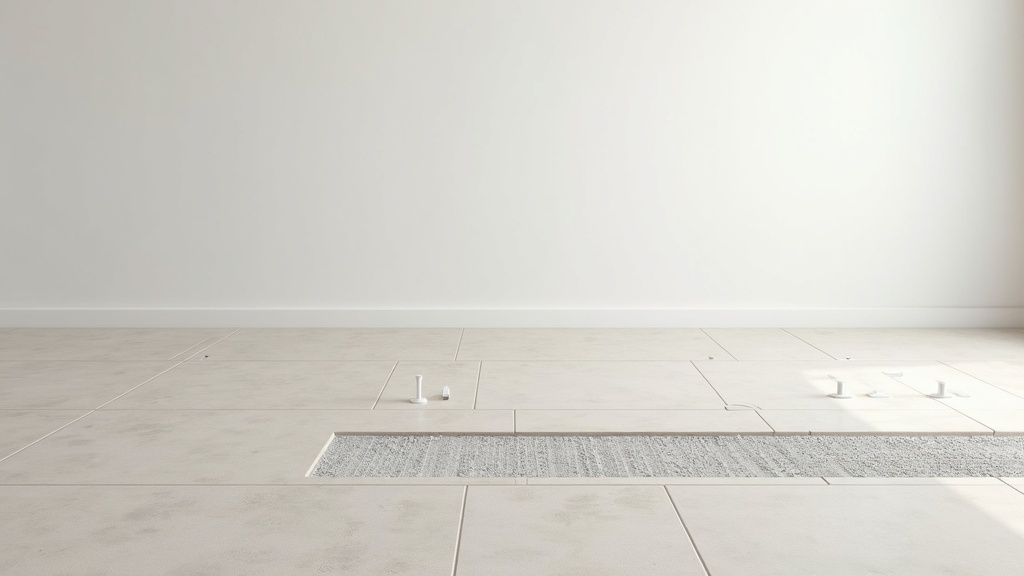
That is the organizing idea worth carrying through the rest of this guide. A tile floor is an assembly of five things, and the tile is the strongest and least likely culprit.
- The structure. Joists and subfloor, which decide how much the floor flexes.
- The substrate. Backer board, mortar bed, or a prepared slab.
- The membrane. Uncoupling or waterproofing, where the assembly needs it.
- The mortar. The bond between substrate and tile, and how completely it is achieved.
- The tile and the grout. The part you see, and the part you maintain.
Choosing tile flooring well means specifying the first four as carefully as the fifth.
Porcelain, ceramic and stone at a glance
Three families cover almost every tile flooring installation, and they differ in ways that decide where each belongs.
| Type | What it is | Water absorption | Best suited to |
|---|---|---|---|
| Porcelain | Denser clay body fired at a higher temperature | 0.5 percent or less | Floors, wet areas, entries, outdoors in freezing climates |
| Ceramic | Softer clay body, usually glazed | Above 0.5 percent, often much higher | Walls, backsplashes, lower traffic interior floors |
| Natural stone | Quarried marble, granite, slate, travertine | Varies widely by stone | Feature floors where sealing and maintenance are accepted |
Porcelain and ceramic: the difference is one number
People treat porcelain and ceramic as a quality ranking. They are actually a technical classification, and the dividing line is water absorption measured under ANSI A137.1. A tile that absorbs 0.5 percent of its weight in water or less is porcelain. Above that, it is ceramic.
That single property drives everything else. A denser body means the tile is harder, less porous and less prone to staining, and unaffected by freezing, because there is almost no water in the body to expand. It is also heavier and harder to cut.
The distinction matters most in two places. Outdoors or in an unheated space in a climate that freezes, a ceramic tile can absorb water, freeze, and spall. Porcelain does not. And in a heavy traffic entry, the same density that limits water absorption also gives a harder surface.
Ceramic is not a lesser product, it is a different one. On a wall, where nothing is dropped and nothing freezes, ceramic is easier to cut, lighter to hang and completely appropriate.
Choose porcelain when the floor gets wet, cold, or heavy use, and ceramic when the application is interior, vertical, or gentle.
Through body, glazed, and why chips show or do not
Most tile is glazed, meaning the colour and pattern are a fired surface layer over a clay body of a different colour. Through body porcelain carries the same colour and composition all the way through.
The difference only appears when the tile is damaged. Chip a glazed tile and you see the body underneath, which is usually a pale beige or white against whatever the surface colour was, and it is obvious. Chip a through body tile and the exposed material looks much like the surface, so the damage disappears at normal viewing distance.
This is also why unglazed porcelain is the usual specification in commercial settings, where chipping is a question of when rather than whether.
PEI, DCOF, and which rating answers which question
Two ratings appear on floor tile specifications and they answer completely different questions. Confusing them is common.
| Rating | What it measures | What to look for |
|---|---|---|
| PEI class | Resistance of the glaze to visible surface abrasion | Class 3 or higher for residential floors, class 4 for busy entries |
| DCOF | Dynamic coefficient of friction, measured wet | 0.42 or greater for level interior floors expected to get wet |
| Water absorption | Density of the clay body | 0.5 percent or less to qualify as porcelain |
| Breaking strength | Load the tile carries before fracture | Relevant for large format tile and heavy point loads |
PEI is a glaze wear rating, not a strength rating. A high PEI class tells you the pattern will not scuff away under traffic. It says nothing about whether the tile will crack, which is a question about what is underneath it. An unglazed through body porcelain may carry no PEI class at all, because there is no glaze to abrade, and that is not a shortcoming.
DCOF is the slip resistance number, measured wet, under ANSI A137.1. The threshold of 0.42 applies to level interior floors that are expected to get wet. It is not a promise of safety in every condition, and a wet sloped shower floor is normally addressed with small tiles and more grout lines, because grout joints provide grip that a large smooth surface does not.
Grout is the maintenance, and the tile is not
Almost everything people dislike about living with tile flooring is actually about grout. It stains, it can crack, and in a shower it is where mould appears. The tile beside it is unaffected.
Cement based grout is the standard, and it is porous. It needs sealing, and resealing periodically, particularly in a shower or a kitchen. Epoxy grout is non porous, so it does not absorb the staining that cement grout does, and it needs no sealing. It is less forgiving to install and harder to work with on a large floor, which is why it is often specified for showers and kitchen backsplashes rather than an entire house.
Joint width is not a purely aesthetic decision either. Larger format tiles have more manufacturing variation across their length, so a wider joint absorbs that variation, and a tight joint that looks precise in a drawing can expose lippage where one tile edge sits higher than its neighbour. Rectified tiles, which are mechanically cut to a precise size after firing, are what allow genuinely narrow joints.
Movement joints matter too. Large tiled areas need a soft joint at the perimeter and at intervals across the field, because the assembly expands and contracts and a floor with nowhere to move will relieve the stress by cracking or by tenting.
What sits under the tile decides whether it lasts
Tile is about as stiff as a pane of glass, and about as willing to bend. Everything in the assembly beneath it exists so that it never has to. That is why tile flooring fails from below rather than from above, and why this is the part of the specification that nobody looks at in a showroom and that decides the outcome.
- Deflection. A wood framed floor has to be stiff enough for tile, and the common benchmark is a deflection limit of L over 360 for ceramic, with natural stone requiring L over 720. A floor that flexes underfoot will crack tile or grout eventually, no matter how good the installation is.
- Substrate. Tile is not bonded directly to plywood in modern practice. Cement backer board, a mortar bed, or an appropriate membrane provides a stable, dimensionally neutral surface.
- Uncoupling membrane. A layer that allows small independent movement between substrate and tile, so a shrinking or moving subfloor does not transmit that stress into the tile. Products of this type are covered by ANSI A118.12.
- Waterproofing. In a shower or wet room, a bonded waterproof membrane to ANSI A118.10 is what contains water. The tile and grout are not the waterproofing layer, and treating them as such is what causes leaks below.
- Mortar coverage. The Tile Council of North America’s handbook sets the expectation at roughly 80 percent coverage for a dry interior floor and 95 percent in wet areas and for exterior work. Voids under a tile are where cracks and hollow spots begin, and large format tile is normally back buttered to achieve full contact.
An installer who talks about deflection, coverage and movement joints before talking about grout colour is telling you they intend to build the assembly rather than just place the tile.
Common mistakes
Each of these is a decision made before any tile is set.
- Choosing tile without checking whether the floor structure is stiff enough for it. This is the single most common cause of cracked tile in older houses.
- Assuming grout and tile are waterproof. They are water resistant surfaces over an assembly that needs its own membrane in wet areas.
- Using a PEI class to judge whether a tile will crack. It rates glaze wear, not structural strength.
- Specifying very narrow grout joints with a non rectified tile, then discovering that natural size variation makes the lines wander.
- Using ceramic rather than porcelain outdoors or in an unheated space where it freezes.
- Skipping movement joints on a large floor, and finding tiles tented along a line months later.
- Choosing a large, smooth, low DCOF tile for a bathroom floor because it looks seamless.
- Leaving cement grout unsealed in a shower and then judging the material by how it looks after two years.
Frequently asked questions
The questions that come up most once tile is on the shortlist.
What is the difference between porcelain and ceramic tile?
Water absorption, and everything that follows from it. Porcelain absorbs 0.5 percent of its weight in water or less, ceramic absorbs more. That density makes porcelain harder, more stain resistant and freeze resistant, and it makes ceramic lighter and easier to cut.
Why does tile crack when the tile itself is so strong?
Almost always because of movement underneath it. A subfloor that flexes beyond its deflection limit, a slab that cracks, a missing movement joint, or a tile set into incomplete mortar coverage will all transmit stress into a material that is very hard and not at all flexible.
Do I need an uncoupling membrane?
It is standard practice over a wood framed subfloor and over any slab that could develop a crack, because it lets the substrate move slightly without carrying that movement into the tile. It is not a substitute for a floor that is stiff enough in the first place.
Is tile too cold or too hard for a living space?
It is harder and colder underfoot than wood or vinyl, and both are solvable. Electric or hydronic radiant heat under tile is common and effective, because tile conducts heat well, and area rugs address the rest. Tile is also the material most compatible with radiant systems.
What does DCOF 0.42 mean?
It is the minimum dynamic coefficient of friction, measured wet, that ANSI A137.1 sets for level interior floors expected to get wet. Above that figure a floor has acceptable slip resistance for that use. It is a specification for a condition, not a guarantee in all conditions.
How long does tile flooring last?
The tile itself outlasts the building in most cases, and fifty years or more is unremarkable. What has a service life is the grout, which may need renewing after ten to twenty years in a wet area, and any sealant, which is a periodic maintenance item rather than a replacement.
Can tile go over an existing tile floor?
Sometimes, if the existing tile is well bonded, flat and sound, and if the added height works at doorways and appliances. It is often not the better choice, because bonding to a glazed surface requires specific preparation and any weakness in the old installation is inherited by the new one.
Related reading
Three related guides, if tile is one of several options you are weighing.
- Flooring types explained, the overview of all six common floors and where each belongs.
- Luxury vinyl plank, the usual alternative when a tiled look is wanted without a tiled assembly.
- Engineered hardwood, for the rooms where tile is the wrong feel underfoot.
Trying to work out whether a floor will take tile? Contact us and we will help you think it through.
To get your project done right, click here for vetted local installers near you.
Sources
The standards this guide cites.
- ANSI A137.1, specifications for ceramic tile, including water absorption classes and DCOF
- ANSI A118.10, load bearing bonded waterproof membranes for thin set tile installation
- ANSI A118.12, crack isolation and uncoupling membranes for thin set tile installation
- Tile Council of North America, Handbook for Ceramic, Glass and Stone Tile Installation
- Porcelain Enamel Institute abrasion classification for glazed tile surfaces