What actually decides how long a carpet lasts?
Fibre and density decide it, and neither is the thing you notice in a carpet flooring showroom. The sample that feels softest under your hand is often the one that will look tired first, because softness usually comes from finer yarn or a longer, looser pile, and both work against wear.
This makes carpet flooring different from every other floor in one specific way. With wood you can see the veneer, with tile you can feel the density, with vinyl you can read a wear layer in mils. With carpet, the two properties that matter most are printed on the back of the sample and are close to invisible from the front.
Three decisions cover almost the whole question, and they are worth taking in this order.
- Fibre. What the yarn is made of, which sets how it behaves with spills, sunlight and foot traffic.
- Construction and density. How tightly the yarn is packed and twisted, which decides whether the carpet keeps its shape or mats down in the traffic lanes.
- Cushion. What goes underneath, which affects service life more than almost anyone expects and is where budgets get cut first.
Colour, pattern and pile style come after those three. They decide whether you like the room. They have very little to do with how the room looks in eight years.
What are the main carpet fibres, and how do they differ?
Five fibres cover nearly everything sold for homes, and the differences between them are chemical rather than cosmetic.
| Fibre | What it is | Behaviour worth knowing |
|---|---|---|
| Nylon | A synthetic polyamide, the most widely specified residential fibre | The most resilient of the common fibres, meaning crushed pile springs back rather than staying flat |
| Polyester (PET) | A synthetic polyester, often made from recycled bottle stock | Hydrophobic, so liquids sit on the surface rather than soaking into the fibre. Less resilient than nylon |
| Triexta (PTT) | A newer polymer, partly derived from corn glucose | Positioned between nylon and polyester on resilience, with polyester’s water behaviour |
| Olefin (polypropylene) | A synthetic polyolefin, solution dyed by nature of its manufacture | Very colourfast and cheap to make. The least resilient, which is why it appears in loop constructions |
| Wool | The natural fibre, usually in premium goods | Naturally resilient, hides soil well, and needs care with bleach and moths |
The distinction that matters most is resilience, which is a fibre’s tendency to return to shape after it is crushed. It is not the same thing as stain behaviour, and people routinely conflate them. A fibre that keeps a spilled drink sitting on the surface may still be the one that goes flat in the hallway, and the reverse is equally true.
Dyeing method is the other lever. Solution dyed fibre has colour added to the polymer before it is extruded, so the colour runs through the strand like a stick of rock. Piece dyed fibre is coloured after the yarn is made, so the colour sits closer to the surface. Because there is no surface layer of dye to lose, solution dyed goods keep their colour through sunlight and through cleaning agents that would strip a piece dyed yarn, which is why they dominate in busy and commercial settings.
Choose nylon or wool where traffic is the problem, and polyester or triexta where the room is quieter and spills are the likelier event.
Cut pile or loop pile: what is the difference?
All carpet flooring starts as yarn looped through a backing. Whether those loops are then cut open is the single biggest structural choice, and it changes how the carpet looks, feels and shows wear.
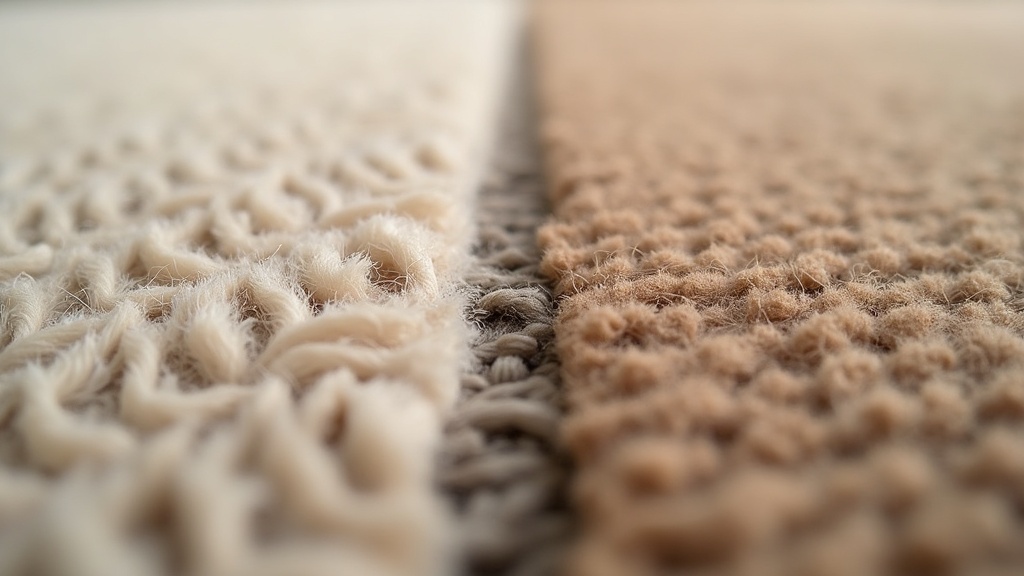
Loop pile leaves the loops intact. It is hard wearing, shows footprints and vacuum marks far less, and is the construction behind berber and level loop goods. Its weakness is snagging: a pulled loop can run, and a pet claw or a dragged chair leg is the usual culprit.
Cut pile shears the loops open so the yarn tips stand upright. It feels softer and richer, takes colour beautifully, and shows footprints and shading because cut tips reflect light differently depending on which way they lean. Plush, saxony and frieze are all cut pile, and they differ mainly in how tightly the yarn is twisted.
Twist is worth understanding on its own. Yarn is twisted and then heat set to hold that twist, and the tighter and better set it is, the longer the tips stay defined instead of splaying open into a matted surface. A frieze carpet is the extreme case, with such high twist that the yarn kinks visibly, which is exactly why it hides traffic so well.
Cut and loop constructions mix the two in one carpet to create pattern and texture, and they hide soil well because the surface is already visually broken up.
What is carpet density, and why does it matter more than face weight?
Density is how tightly the yarn is packed into the backing, and it is the closest thing carpet flooring has to a single quality number. Face weight, the figure most often quoted on a sample, is only half the story.
Face weight is the ounces of yarn per square yard. The problem is that a tall, loosely packed pile and a short, tightly packed one can carry identical face weights and behave nothing alike. Density corrects for that by bringing pile height into the calculation.
The standard formula is face weight divided by pile height, multiplied by 36. A carpet with a 50 ounce face weight and a half inch pile gives a density of 3,600. The same 50 ounces at a 3/4 inch pile gives 2,400, and it is the same yarn spread thinner.
Think of pile density the way you would think of bristles on a brush. It is not the length that keeps the head in shape, it is how tightly the tufts are packed together. Loosely spaced bristles splay outward the moment they are pushed; densely packed ones hold each other upright.
There is a check you can do on a sample without any numbers at all. Bend a corner back on itself, pile side out. The more backing you can see through the splayed yarn, the lower the density. A dense carpet barely opens up.
Why does the cushion underneath matter so much?
The cushion is the layer of foam, rubber or fibre between the carpet and the subfloor, and it is where budgets get trimmed to protect the carpet allowance. That is close to backwards.
The cushion absorbs the impact of every footstep before it reaches the carpet backing. Too soft or too thick and the carpet flexes more than it was built to, working the backing and the tufts loose over time. Manufacturers are direct about this: most residential warranties specify both a maximum thickness and a minimum density for cushion, and installing outside those limits can void the carpet warranty entirely.
The figures commonly specified for residential cut pile are a maximum thickness around 7/16 of an inch and a minimum density around 6 pounds per cubic foot, with firmer and thinner cushion called for under loop constructions and in heavy traffic. The specific numbers come from the carpet manufacturer rather than from a single industry standard, so the practical step is simple: read the warranty document for the carpet you are buying before choosing the cushion, because that is the document that will be quoted back to you.
How is carpet installed?
Two methods cover residential carpet flooring, and the difference is whether the carpet is stretched or stuck.
- Stretch in over cushion. Tack strip is fastened around the perimeter, cushion is laid inside it, and the carpet is stretched across the room and hooked onto the pins. This is the standard residential method and the one that gives carpet its underfoot feel.
- Glue down. The carpet is adhered directly to the subfloor, with or without a bonded cushion. It is firmer underfoot, dimensionally stable, and usual in commercial settings and on stairs and ramps.
For stretch in work, one detail separates a floor that stays flat from one that ripples: how it was stretched. The Carpet and Rug Institute’s residential installation standard, CRI 105, calls for a power stretcher. A knee kicker is a positioning tool, not a stretching tool, and a room stretched with one alone will very often develop ripples as the carpet relaxes.
This is worth asking about directly, because it is invisible once the job is done and a great deal harder to put right afterwards. An installer who mentions power stretching before you raise it is telling you something useful.
Two smaller points matter as well. Seams are planned rather than accidental, and a good installer will place them away from the main sightline and out of the highest traffic path. And carpet, cushion and adhesive can all be specified with a Carpet and Rug Institute Green Label Plus certification, which tests for low volatile organic compound emissions, if indoor air quality is a concern in the household.
Common mistakes
These come up repeatedly, and every one of them is decided before the carpet goes down.
- Buying on how a sample feels. Softness usually comes from finer yarn or a longer pile, and both work against how it wears.
- Comparing face weight between carpets with different pile heights. Without dividing by pile height, the number is not comparable.
- Confusing stain behaviour with resilience. They are separate properties of the fibre, and the best carpet for a juice spill is not automatically the best for a hallway.
- Saving money on the cushion. It is the layer that decides how hard the carpet works, and the wrong specification can void the carpet warranty.
- Putting loop pile in a house with cats. A pulled loop runs, and claws find loops.
- Accepting a stretch in installation without a power stretcher. Ripples that appear months later are a stretching problem, not a product fault.
- Choosing a plain, light, low twist cut pile for a busy hallway, then being surprised by traffic lanes. Pattern, mid tones and high twist all hide wear.
- Ordering exactly the measured area. Carpet comes in fixed roll widths, so seam placement and pattern repeat drive the real quantity, and a plan drawn before ordering avoids a seam in the worst possible place.
Frequently asked questions
These are the questions that come up most once carpet is on the shortlist.
Which carpet fibre is the most hard wearing?
Nylon is the most resilient of the common synthetics, which means crushed pile recovers rather than staying flat, and wool performs similarly among natural fibres. Resilience is the property that decides how a traffic lane looks after several years, so it is the one to weight most heavily where traffic is the concern.
Is polyester carpet any good?
Yes, in the right room. Polyester is hydrophobic, so liquids tend to sit on the surface rather than wick into the fibre, and it takes rich colour well. It is less resilient than nylon, so it suits bedrooms and quieter living spaces better than a main hallway or a stair.
What carpet density should I look for?
Higher is better within the same pile style, and the useful move is to compare density rather than face weight between the carpets on your shortlist. Calculate it as face weight divided by pile height times 36, then use the bend test on the sample as a sanity check: the less backing that shows when you fold it back, the denser the carpet.
Can carpet go in a basement?
It can, with attention to what is underneath. Concrete passes moisture upward, so a slab moisture test and a synthetic cushion rather than a fibre one are the usual precautions, and any history of water in the space is a reason to choose a different floor. Carpet tiles are a common alternative below grade because a damaged section can be lifted and replaced individually.
How long does carpet last?
Service life depends far more on fibre, density, cushion and traffic than on the price of the goods, which is why two carpets bought the same year can look a decade apart. Manufacturer warranties are the checkable anchor and commonly run from around five years on entry level goods to twenty five or more on premium constructions, with the term describing wear under normal use rather than predicting the life of the floor.
Does carpet make allergies worse?
The evidence is more mixed than the common assumption suggests, because carpet holds particles in the pile rather than letting them circulate, which cuts both ways depending on how often it is vacuumed. The practical guidance is the same either way: vacuum frequently with a sealed system machine, deal with spills quickly so nothing grows in the backing, and look for a Green Label Plus certification on the carpet, cushion and adhesive if emissions are a concern.
Related reading
Three guides that sit alongside this one.
- Flooring types explained, the overview of all six common floors and where each belongs.
- Luxury vinyl plank, the usual alternative where moisture rules carpet out.
- Solid hardwood flooring, for the rooms where a hard surface is the better answer.
Trying to work out which fibre suits a specific room? Contact us and we will help you think it through.
To get your project done right, click here for vetted local installers near you.
Sources
The authorities this guide draws on.
- Carpet and Rug Institute, CRI 105 standard for installation of residential textile floorcovering
- Carpet and Rug Institute, Green Label Plus indoor air quality testing program for carpet, cushion and adhesive
- Carpet manufacturer warranty documentation, for cushion thickness and density requirements