What actually separates click lock from glue down?
One question: is the floor allowed to move? A click lock floor floats, fastened to nothing, and travels as a single connected sheet as temperature and humidity change. A glue down floor is bonded to the subfloor and does not travel at all.
Almost every practical difference between the two follows from that. How the floor sounds underfoot, how flat the subfloor has to be, what fails when something goes wrong, how a damaged plank is replaced, and how the floor behaves in a sunny room are all downstream of whether it is permitted to move.
The click lock vs glue down decision is usually framed as a question about installation difficulty. It is more useful to treat it as a question about the room, and mostly about the subfloor underneath it.
Click lock vs glue down at a glance
Four properties cover most of the click lock vs glue down comparison.
| Property | Click lock (floating) | Glue down |
|---|---|---|
| Attachment | Planks lock to each other, not to the subfloor | Each plank adhered to the subfloor |
| Movement | Expands and contracts as one sheet, needs a perimeter gap | Held in place, no perimeter gap needed |
| Underfoot | Slightly softer, can sound hollow | Solid and quiet, no give |
| Repair | Boards can be unclicked back from a wall, or cut out mid floor | Individual planks cut out and re-adhered |
Which one is more forgiving of a bad subfloor?
Neither, and this is the most common misconception about floating floors. Click lock is forgiving of a subfloor you cannot fasten to. It is not forgiving of one that is uneven.
A rigid floating plank spans a dip rather than settling into it, which leaves an unsupported void underneath. That is what produces a hollow spot underfoot, and over time it stresses the locking joint that is bridging the gap. A thin glue down plank does the opposite: it follows the substrate so faithfully that a trowel ridge or a screw head reads through to the surface, which is visible rather than audible.
Both failures are subfloor preparation problems wearing different clothes, and both are measured against the same benchmark. About 3/16 of an inch over ten feet is the usual flatness figure, taken from the ASTM F710 practice for preparing concrete to receive resilient flooring.
Over concrete, both methods call for a moisture test before anything goes down, usually an in situ relative humidity test to ASTM F2170. Glue down adds a second constraint, because the adhesive itself has a moisture limit that the manufacturer states.
What does each one feel and sound like?
Glue down is the more solid of the two, and it is not a subtle difference once you have walked on both. There is no give, no flex at the joints and no drum effect, because there is no air anywhere in the assembly.
A floating floor rests on an underlayment with a thin air path beneath it, so footfall has somewhere to resonate. Good underlayment, a thicker or denser plank and a genuinely flat subfloor all reduce it. Nothing eliminates it entirely, because the gap is what makes the floor float.
In an apartment or condominium this stops being a preference and becomes a requirement. Model building codes across North America set a minimum impact insulation class of 50 for the assembly between dwelling units, measured to ASTM E492, and many buildings set their own higher figure. The rating belongs to the whole floor and ceiling assembly rather than to the plank, so the number that satisfies a building is the one for the specified underlayment and floor together.
Where does each method fail?
They fail in opposite directions, and knowing which failure you are risking is more useful than a general preference.
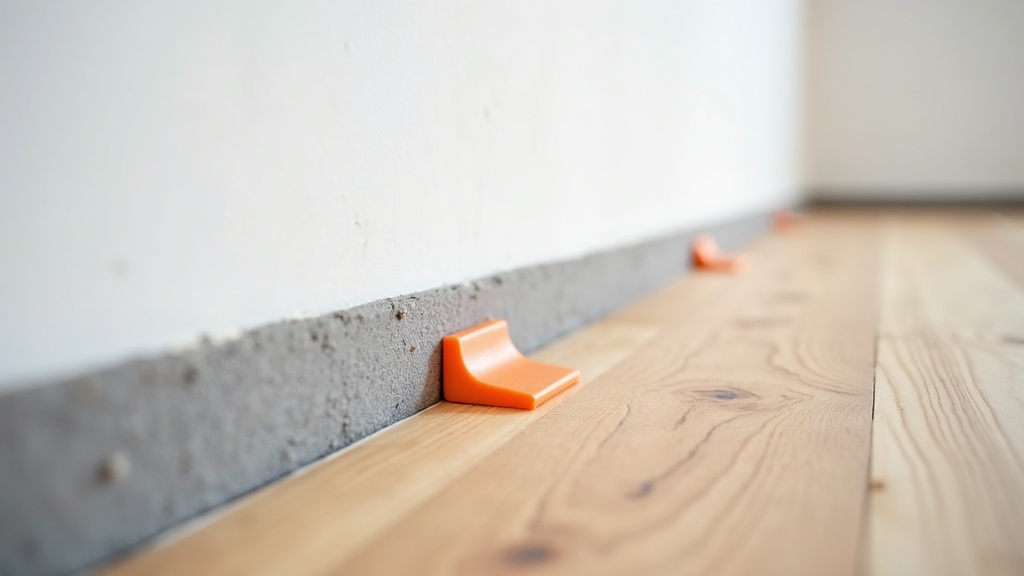
A floating floor fails by being trapped. It grows and shrinks as one large sheet, so if it is pinched at a doorway, fitted tight under trim, or held down by a kitchen island built on top of it, the expansion has nowhere to go but up.
It behaves like a sheet of ice on a pond: it moves as one piece, and if it is held fast at the edges the pressure surfaces somewhere in the middle. The ridge or peak usually appears a long way from the pinch point that caused it. Long runs without a transition and strong direct sunlight both make this more likely, which is why manufacturers cap run lengths and give specific guidance for sunrooms.
A glue down floor fails by losing its bond. That comes from moisture arriving through the slab, an adhesive applied outside its open time or spread rate, or a substrate that was not clean. The symptom is a hollow or loose plank rather than a ridge, and it stays local rather than moving the whole floor.
One is a movement failure and the other is a bond failure. Both are preventable, and both are decided before the first plank is laid.
Which is easier to repair or remove?
Floating floors are easier to remove and often easier to repair, which matters more than people expect over the life of a floor.
Because nothing is stuck down, a floating floor can be unclicked from a wall back to a damaged plank and reassembled, or a single board can be cut out mid floor and replaced with a specialist joint. When the floor is eventually replaced, it lifts rather than being scraped, and the subfloor underneath is left clean.
A glue down plank is cut out and a new one bedded in its place, which is a competent installer’s routine job but a messier one. Full removal means scraping adhesive, and on a slab that can be the largest part of the next project.
Keeping spare boards from the original run matters for both, because a later production run will not match.
Which should you choose?
Settle click lock vs glue down by working through the room rather than the product.
- Is the subfloor flat and sound, and can you tolerate the mess of adhesive? If yes, and you want the most solid feel, glue down.
- Is this a condominium with a sound requirement? The assembly decides it, and the specified underlayment usually points to floating.
- Is the room very large, very sunny, or does it run into other rooms without transitions? Those conditions push toward glue down, or toward a floating floor installed strictly to the manufacturer’s run length guidance.
- Do you want the floor to be removable later with the subfloor left intact? Floating.
- Is there heavy fixed cabinetry going in on top? Glue down avoids the pinning problem entirely.
Common mistakes
These come up repeatedly and every one is decided before the floor goes down.
- Choosing floating because the subfloor is uneven. Rigid planks bridge dips rather than following them, which is exactly what creates hollow spots.
- Skipping or skimping the expansion gap, or fitting trim hard against a floating floor so it is clamped.
- Building a kitchen island or heavy fixed cabinetry on top of a floating floor, which pins it at one point and forces the movement out somewhere else.
- Adding underlayment beneath a plank that already has a pad attached, which gives too much and stresses the locking joints.
- Gluing down without checking the adhesive’s own moisture limit against the slab test result.
- Running a floating floor from room to room through doorways without transitions, past the length the manufacturer allows.
- Assuming a floating floor is quieter because it is softer. Solid contact is what makes a floor quiet, which is why glue down is the quieter method.
Frequently asked questions
The questions that come up most when choosing between the two methods.
Is glue down better than click lock?
Neither is better in the abstract. Glue down gives the most solid feel and no movement to manage, at the cost of a flat and clean subfloor requirement and a messier removal later. Click lock installs faster, lifts cleanly, and needs its expansion room respected.
Why does my floating floor sound hollow?
Usually because it is spanning dips in the subfloor rather than resting on it, so there is unsupported air underneath. Underlayment choice and plank thickness affect it, but a hollow sound in specific spots almost always points to flatness rather than to the product.
Can a floating floor go under kitchen cabinets?
The usual practice is to install cabinets first and float the floor up to them, so the floor is never pinned. Building heavy fixed cabinetry on top of a floating floor traps it, and the expansion that has nowhere to go appears elsewhere in the room.
Does glue down need an expansion gap?
Not in the way a floating floor does, because each plank is held in place and the floor does not travel as a sheet. Manufacturers still specify perimeter details and movement accommodation on large areas, so their instruction governs rather than the general principle.
Which method is better over radiant heat?
Both are used, and the deciding factors are the product’s own rating and how the heat reaches the room. Glue down puts the plank in direct contact with the heated substrate, while a floating floor adds an underlayment layer whose thermal resistance has to be low enough to let the heat through. The manufacturer’s stated surface temperature limit applies either way.
Can I glue down a plank that is sold as click lock?
Sometimes, and only where the manufacturer says so. Some rigid core products are approved for both methods and others are not, and gluing a product that is not rated for it can void the warranty. This is a specification question rather than a judgement call.
Related reading
The guides behind this comparison.
- Luxury vinyl plank, where both methods are common and the core type interacts with the choice.
- Laminate flooring, which floats in every residential installation.
- Engineered hardwood, which can be floated, glued or nailed depending on its core.
Not sure which method suits your subfloor? Contact us and we will help you think it through.
To get your project done right, click here for vetted local installers near you.
Sources
The standards behind the figures above.
- ASTM F710, standard practice for preparing concrete floors to receive resilient flooring
- ASTM F2170, in situ relative humidity testing of concrete floor slabs
- ASTM E492, laboratory measurement of impact sound transmission through floor and ceiling assemblies